
Moral Orienting Systems & Mapping Moral Suffering

Recently, I had the opportunity to lead two didactic sessions on moral injury with Clinical Pastoral Education (CPE) students at Naval Medical Center Portsmouth. In teaching others about moral injury over the years, I’ve learned that most people know what it is. Rather than a new concept, education gives people specific language to frame how they make sense of their experience. During one of the sessions, one student asked, “What IS the difference between moral injury and PTSD? Also, how does any of this apply outside of clinical and counseling settings?”
The CPE student raises an important question. The prevailing understanding of moral injury is that it leads to negative thoughts, emotions, and behaviors that affect individual flourishing. This understanding creates a tendency to pathologize all forms of moral suffering. Moral injury becomes a catchall term, thus losing its distinctiveness and importance. Furthermore, pathologizing and overusing the term makes it very difficult to envision how moral injury can be a useful concept outside of medical and therapeutic paradigms. Is there a way to envision moral injury’s utility, especially for leadership development and thriving organizational cultures?
“In instances where one’s moral identity cannot assimilate or accommodate the experiences within that situation, moral stress is generated as a challenge for meaning-making and adaptation toward a modified moral identity that can reconcile within the environment. However, one’s moral identity is not solely a matter of brain cognition but rather is contained by one’s embodied knowledge….Moral stress is a physiological response to identity-threatening circumstances; therefore, moral stress must not be regarded as a failure to thrive but rather a whole self moving toward finding new ways to survive and inhabit a meaningful life.”1
Dr. Zachary Moon, Brite Divinity School, developed the concept of moral orienting systems as a response to pathological understandings of moral injury. Rather than expressing and understanding moral injury in purely cognitive/behavioral terms, moral orienting systems call for examination of the fundamental systems and experiences that ground and shape one’s moral worldview. Moral injury arises when one’s moral orienting system is limited or unable to reconcile moral challenges that arise within one’s experience. At the same time, moral orienting systems can also be a source of resiliency and recovery, providing a reference point for meaning-making and positive relationships. Grounded in Moon’s experience as a military chaplain and ongoing work in interdisciplinary approaches to moral injury, the concept of moral orienting systems offers an expansive way to address moral injury beyond medical models.2 Moon writes, “One’s moral orienting system is simultaneously idealistic and practical, a dynamic interplay between one’s desires, hopes, and expectations and one’s experiences in various situations.”3
I’m interested in the durability and adaptability of moral orienting systems under varying degrees of moral suffering. Concretely, how does moral suffering affect, alter, or erode one’s moral orienting system, and does that affect the ability to decide and act morally? For communities, organizations, and those who lead them, this is a crucial question. Experiences that lead to the deformation of a moral orientation system may render a community or individual unable or unwilling to be moral in situations they would normally be able to be moral in, similar to Shay’s witnessing of the “undoing of character” in previously good Vietnam veterans.4 Deformed or undone moral orienting systems may put oneself and others at further risk for harm and moral suffering, including moral injury.
This provides a means to respond to the CPE student’s questions raised at the beginning of this post. We can map moral suffering across varying levels of severity, specifically in terms of how it impacts individual and communal moral orienting systems. More descriptive than evidence-based, I hope what follows helps leaders envision how understanding degrees of moral suffering, including moral injury, can lead to a more just, safe, and thriving society.
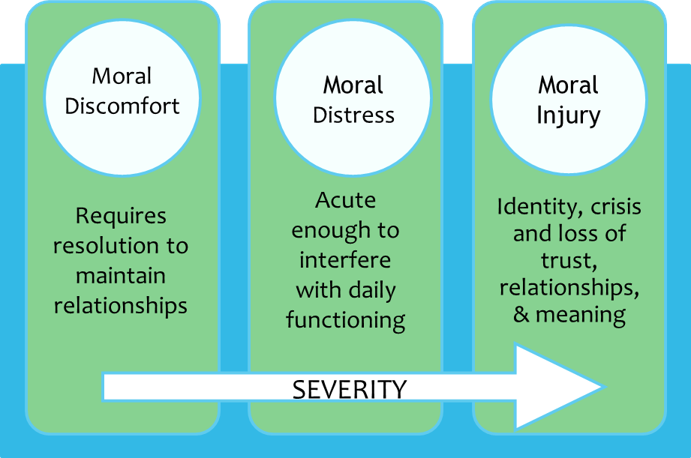
Graphic Credit: Rita Nakashima Brock, 2023 Lecture “Unbinding Souls: The Use of Ritual in Moral Injury” (Durham University, International Centre for Moral Injury).
Moral Discomfort. In many ways, moral discomfort isn’t much different from the moral challenges people and communities face every day. However, moral discomfort can reach a level that leads to uncertainty or confusion about how to act. It can cause leaders and organizations to freeze or make further misjudgments. It can cause us to question what others are saying and doing. The experience of moral discomfort can be quite painful, although not completely debilitating. One can still discern right from wrong and act accordingly.
Moral discomfort can be described as “bruising.”5 Like a physical bruise, moral discomfort is visible and painful, but, depending on one’s tolerance level, isn’t debilitating. With regard to moral orienting systems, moral discomfort amplifies it; one becomes aware that one's experience is in conflict with it and that it needs to be addressed. However, this implies a level of resiliency of the moral orienting system to deal with the conflict. Pathways to recovery that resolve the moral discomfort are straightforward (although not always easy).
Moral distress. In a previous military assignment, I served under an extremely toxic and unethical leader. Everyone in the unit witnessed his transgressions and, at times, was subjected to them. The distress we experienced affected our daily functioning as a team and as individuals, affecting our overall well-being. The experience was quite painful and, at times, felt unbearable. Yet another effect emerged, perhaps more serious. To avoid, minimize, or manage the pain, people, including myself, began making moral compromises. People who were normally courageous and trusted remained complicit and silent. Others began to hide mistakes that would normally be reported. Trust and cohesion were eroded as people’s actions were interpreted with suspicion and ill intent.
Moral distress significantly stresses and shifts moral orienting systems. The result is analogous to a sprained joint or limb. Like a physical sprain, moral distress causes pain and suffering that necessitate modifications or compromises in order to reduce or eliminate it. Rather than choosing to go against one’s moral orienting system outright, it is changed to accommodate those actions and decisions. This moral sprain, however, without proper support and time to recover, can result in more permanent, long-term damage to the moral orienting system, or moral injury.
Moral Injury. Moral injury scholars agree that moral injury is the most extreme form of moral suffering, resulting from a devastating experience of betrayal, shame, and loss that affects meaning-making, relationships, and “shattered assumptions”6 about goodness. “Injury” suggests a more permanent condition from which one may heal, but never fully return to its prior state. “Moral” points to something more complex than a series of psychic responses created by inner conflict with beliefs and values. Therefore, it is not merely about how the individual is affected, but also about how their entire environment is affected. Understanding moral orienting systems provides a framework for processing moral injuries and for how they affect both individuals and the contexts in which they occur.
I am also interested in how moral injuries significantly and permanently alter a moral orienting system, and how that affects a leader or community’s ability to think and function morally. In my experience, the most severe moral injuries lead to major compromise and loss of moral reference point. Without this, pain and suffering instead guide how one lives in the world. Whether internalized or transmitted, moral pain and suffering can cause individuals and communities to perpetuate moral harm and create additional suffering. How often have we seen organizations or leaders cause harm and yet believe they did nothing wrong? A compromised moral orienting system may be the reason.
Mapping moral suffering in terms of moral orienting systems has two implications for leadership and community integrity. One, moral failings, transgressions, and conflicts, rather than strictly willful acts, may originate in a moral orientation system affected by past experiences of unresolved moral suffering. If that’s the case, then it suggests an increased role in restorative justice, making amends, and collective repair as possibilities for recovery. Two, it also necessitates the role of moral agents who can serve as reference points in working with compromised moral orienting systems. This isn’t to “give” or assimilate individuals and communities into adopting specific moral orienting systems to replace existing ones, but rather to provide an anchor for meaningful reflection and exploration of them. This is why chaplains are effective resources to address moral injury. Trained to balance the religious traditions they represent and to provide care and guidance in pluralistic settings, chaplains serve as a reference point from which moral orienting systems can be tested, compared, validated, and affirmed.
Of course, there are other possibilities for recovery and moral agents beyond chaplains. Moral orienting systems and how they’re affected by degrees of moral suffering offer leaders and organizations an opportunity to better understand the underlying assumptions and worldviews that inform their decisions and actions, and vice versa. It also provides a means to address the legacies of harm and suffering when discerning future directions and development of organizations and leaders. Ultimately, morality is an unavoidable part of life. The better we understand the foundations for which we understand morality, the more effective we can be in creating the just and equitable world we desire to live in.
Zachary Moon. "Warriors between Worlds: Moral Injury and Identities in Crisis.” (Lexington Books, 2019), 24.
See abstract for forthcoming article: https://www.frontiersin.org/journals/psychiatry/articles/10.3389/fpsyt.2026.1733645/abstract
Ibid.
Refer to Jonathan Shay’s landmark book, “Achilles in Vietnam: Combat Trauma and the Undoing of Character” (Simon and Schuster, 1995).
The term came from a student’s capstone project presentation during the 10-week Moral Injury Certificate Program (MICP) that I help teach. MICP attracts professionals from medical, social service, chaplaincy, and education who want to learn more about moral injury and recovery. The capstone gives students an opportunity to integrate what they’ve learned into their current field and work practice.
See Ronnie Janoff-Bulman’s work. “Shattered Assumptions: Towards a New Psychology of Trauma” (Free Press, 1992).